I Ran 5 AI Agents on One Codebase. One Caught a Bug, the Others Missed.
Here’s something that should make you uncomfortable.
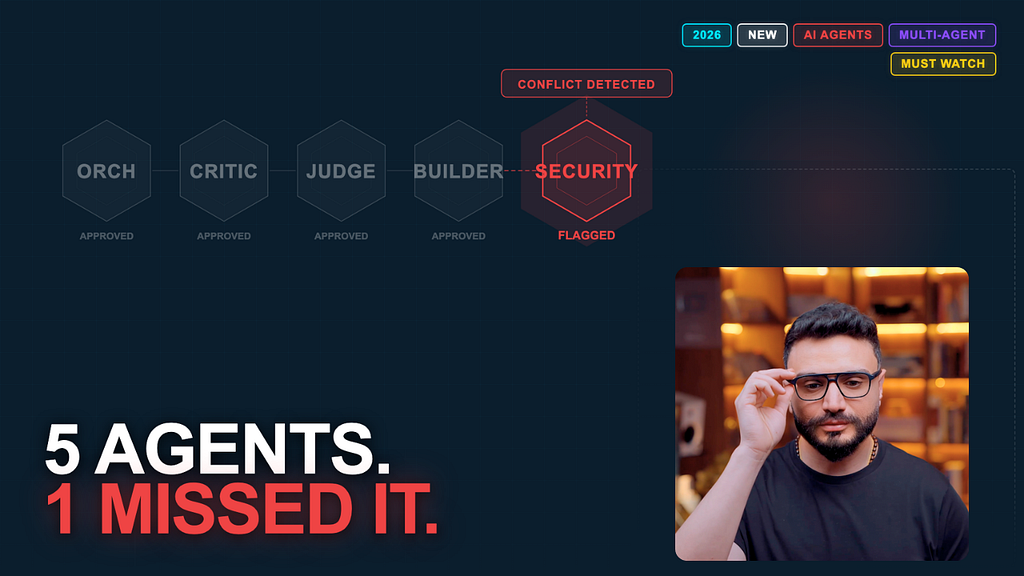
I ran a 5-agent code-review pipeline on a real Next.js and Prisma codebase. Four agents approved the pull request. One flagged it.
The one that flagged it was right.
The bug was a soft-delete data exposure flaw — deleted records leaked into the API response because a single filter condition was missing. The kind of bug that passes human review. The kind that passes single-agent AI review. The kind that ships to production.
It took a multi-agent architecture to catch it.
Why Single-Agent Review Fails
When you ask one LLM to review your code, you get one perspective. One set of priorities. One blind spot.
The model that’s optimizing for clean logic isn’t simultaneously optimizing for security. The model-checking style doesn’t consider data exposure. You’re collapsing five different lenses into one — and hoping it covers everything.
It doesn’t.
The Architecture
I built a five-agent pipeline on MiniMax M2.7 with a 200K context window:
- Orchestrator — coordinates the pipeline, routes the PR
- Critic — logic, maintainability, code quality
- Builder — implementation correctness, edge cases
- Security — CVE-class issues, data exposure, injection risks
- Judge — final arbiter when agents disagree
Each agent runs independently. Each brings a different mandate. When they disagree, that disagreement is the signal.
Four agents approved. The Security agent flagged. The Judge was forced to arbitrate. That conflict caught the bug.
The Flaw
typescript
const posts = await prisma.post.findMany({
  where: {
    userId: session.user.id,
    // missing: deletedAt: null
  }
})
One missing filter. Deleted records returned in the API response. Data that should be invisible to users should be fully accessible.
The Critic didn’t catch it. Logic looked fine. The Builder didn’t catch it. Implementation was correct. The Security agent caught it — because its entire mandate is to look for data exposure patterns.
That’s the point.
Why MiniMax M2.7
Multi-agent pipelines are expensive when every agent call burns tokens independently. M2.7’s 200K context window changes the economics. The entire codebase fits in context. The orchestration overhead drops. The cost per pipeline run becomes viable.
I ran the full pipeline on a real production-scale codebase for a fraction of what this would cost on GPT-4.
What This Means for Your Code Review Process
Single-agent review is better than no review. But it’s one perspective pretending to be five.
A multi-agent architecture doesn’t add complexity for its own sake — it adds specialization. And specialization catches what generalization misses.
The full pipeline, the architecture diagram, and the GitHub repo are in the video below.
Watch the full build → https://youtube.com/@atefataya
If you’re building AI pipelines and want to go deeper, I publish technical deep dives every week. No hype. No summaries of press releases. Just architecture that works.
Subscribe, and I’ll see you in the next one.
Full tutorial
Atef Ataya — AI architect, author of The Architect’s Playbook, creator of Depwire. YouTube: youtube.com/@atefataya