The AI Agent Accountability Gap Nobody Is Talking About
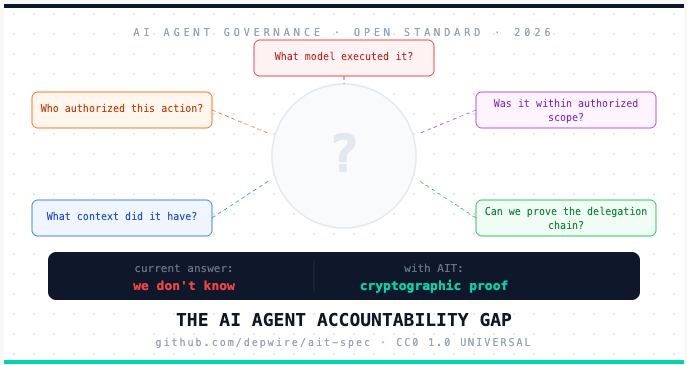
Every week, another enterprise announces they are deploying AI agents into production. Autonomous systems that read internal documentation, write code, call APIs, manage databases, and coordinate with other agents to complete multi-step tasks without human intervention.
And every week, the same question goes unanswered in every architecture review, every security audit, every boardroom where someone asks: if something goes wrong, how do we know exactly what the agent did, what it knew, and whether it was authorized to do it?
The honest answer, at every major organization deploying AI agents today, is: we don’t. Not with cryptographic certainty. Not in a way that survives a security audit. Not in a way that satisfies the question a regulator or a CISO will eventually ask.
This is the accountability gap. And it is about to become the most expensive problem in enterprise AI.
What Happens When an Agent Acts Without a Paper Trail
Consider a scenario that is already happening at organizations using autonomous AI coding agents.
A parent orchestrator agent receives a task: refactor the authentication module. It spawns three worker agents. Worker 1 reads the existing code. Worker 2 proposes changes. Worker 3 commits them to a staging branch.
By morning, the authentication module has been modified. The tests pass. The code looks reasonable.
Three weeks later, a security researcher finds a vulnerability in the new authentication logic. The question is asked: What authorized this change? What context did the agent have when it made this decision? Was this action within the scope it was granted?
The answer comes back: we have a git commit. We have application logs. We have timestamps.
What we do not have is a cryptographic record of what the agent knew, what model version executed the decision, what scope it was operating under, or whether the parent agent that spawned the worker had the authority to grant those permissions in the first place.
The paper trail exists. The audit trail does not.
The Delegation Problem Is Worse Than It Looks
Single-agent systems are manageable. You can trace what one agent did, even if imperfectly.
Multi-agent systems introduce a compounding problem that the security community has not yet formally addressed at scale: identity laundering.
When a parent agent spawns a child agent and delegates capabilities, there is currently no cryptographic mechanism to verify:
- That the child’s actions were within the scope the parent actually granted
- That the parent had the authority to grant that scope in the first place
- That the delegation chain traces back to a human authorization event
An agent can claim it was authorized. It can claim its parent authorized it. It can claim the action was within scope. Without a cryptographic chain, these are assertions, not proofs. They are as trustworthy as a handwritten note.
The enterprise security community has a term for what happens when identity and authority claims cannot be verified cryptographically: identity laundering. The action is performed by “the agent”, a convenient abstraction that absorbs accountability without providing it.
What NIST Sees Coming
In February 2026, NIST published a concept paper titled “Accelerating the Adoption of Software and AI Agent Identity and Authorization.” It was unusually direct for a government standards body.
The paper identified three requirements that do not yet have standardized solutions:
- Persistent cryptographic agent identifiers: not session tokens, not API keys, but verifiable identities bound to specific models and authorized scopes
- Non-repudiation for agent actions: cryptographic proof that a specific agent, running a specific model, took a specific action with a specific context
- Verifiable delegation chains: mechanisms to prove that child agents operated within the scope granted by parent agents, traced back to human authorization
NIST called for industry-led standards. The comment period closed on April 2, 2026.
The window for the industry to define this standard before it is defined for us is open right now. Not for long.
The “Lethal Trifecta” That Security Researchers Are Watching
Independent of the governance question, security researchers have identified what they call the “Lethal Trifecta”, the combination of capabilities that makes an AI agent a high-value target for adversarial exploitation:
- Access to private data: internal documentation, codebases, databases
- The ability to ingest untrusted content: web search, email, support tickets, external APIs
- Authority to act externally: committing code, sending emails, calling webhooks, modifying infrastructure
An agent with all three capabilities and no cryptographic audit trail is not just a governance problem. It is an incident waiting for a calendar invite.
When that incident happens — and it will — the question that matters is not “what did the logs say” but “what can we prove, cryptographically, about what the agent was authorized to do and what it actually did.”
The Gap Cannot Be Closed With Logs
The instinctive response to the accountability gap is better logging. More observability. OpenTelemetry traces. Centralized audit logs.
Logs are necessary. They are not sufficient.
A log records that an event occurred. It does not cryptographically bind that event to the agent’s identity, model state, authorized scope, and context at the moment of execution. Logs can be tampered with. Log pipelines can fail. Log retention policies create gaps.
More fundamentally, a log entry that says “agent modified file X” answers the what. It does not answer the who with certainty, the why with proof, or whether it was authorized with non-repudiation.
Enterprise security requires non-repudiation. The AI agent ecosystem does not yet have a standard for providing it.
Introducing AIT: Agent Identity Token
The Agent Identity Token is an open standard we drafted to close this gap. It is published under CC0 1.0 Universal — public domain, no patents, no proprietary extensions. The goal is a standard the industry can adopt independently of any single vendor.
AIT is built on JWT (RFC 7519) and defines three token types that chain together to form a complete, cryptographically verifiable record of every agent action:
AIT-S — Session Token Issued when an agent session begins. Binds the agent’s UUID to a specific model, provider, and authorized scope. Signed with RS256. References the human authorization event that initiated the session.
AIT-A — Action Token Issued for each atomic action — a tool call, a file write, a command execution. References the session token. Includes the SHA-256 hash of the model’s complete active context window at the moment of action, binding the action to exactly what the model observed. Includes file state hashes before and after for write operations.
AIT-D — Delegation Token Issued when a parent agent spawns a child agent. References the parent session. Enforces strict scope subsetting — the child cannot be granted permissions the parent does not have. Creates a verifiable delegation chain that prevents identity laundering.
Every AIT-A traces back through the delegation chain to a root AIT-S authorized by a human. No orphan actions. No unverifiable authority claims. No identity laundering.
What This Looks Like in Practice
When an orchestrator agent begins a session, it receives an AIT-S token:
{
  "typ": "AIT-S",
  "agent_id": "uuid-of-this-agent",
  "model": "claude-sonnet-4-20250514",
  "model_provider": "anthropic",
  "scope": {
    "read": ["src/**"],
    "write": ["src/**"],
    "execute": ["npm", "git"],
    "deny": ["*.env", "secrets/**"]
  },
  "human_ref": "sha256-of-human-authorization-event"
}
When it spawns a worker agent to write tests, it issues an AIT-D token that explicitly limits the worker’s scope:
{
  "typ": "AIT-D",
  "parent_agent_id": "orchestrator-uuid",
  "child_agent_id": "worker-uuid",
  "delegated_scope": {
    "read": ["src/tests/**"],
    "write": ["src/tests/**"],
    "execute": ["npm test"],
    "deny": ["src/auth/**", "*.env", "secrets/**"]
  }
}
When the worker modifies a test file, it issues an AIT-A token:
{
  "typ": "AIT-A",
  "session_ref": "delegation-token-jti",
  "action": { "type": "file_write", "target": "src/tests/auth.test.ts" },
  "context": { "hash": "sha256-of-what-the-model-saw" },
  "state": { "prev_hash": "sha256-before", "post_hash": "sha256-after" }
}
Every token is signed with RS256. Every token is verifiable offline without a central authority. The chain is tamper-proof.
The Standard Is Open. The Conversation Has Started.
The AIT specification is live at https://github.com/depwire/ait-spec. It includes the full RFC-style specification, machine-readable JSON schemas for all three token types, and example token chains.
In less than 24 hours, 56 developers cloned the repository. 38 unique visitors read the spec. The conversation has started.
NIST has been contacted directly. The specification is designed to align with the NIST AI RMF and the February 2026 concept paper on AI agent identity.
The public comment period has closed. But the standardization process has not. The industry still has the opportunity to define this standard before it is defined for us.
If you are building AI agents, deploying them in enterprise environments, or thinking about what AI governance looks like in practice — the spec is public domain. Read it, critique it, implement it, fork it. That is how open standards are built.
https://github.com/depwire/ait-spec
AIT Specification v0.1.0-draft — CC0 1.0 Universal (public domain)