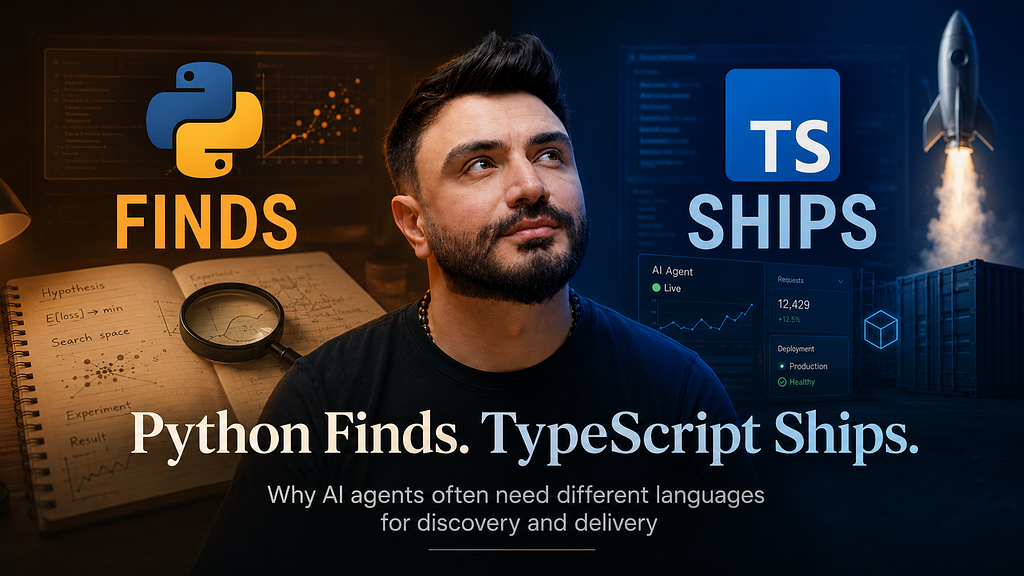
Python Finds. TypeScript Ships.
There is a debate happening right now in the AI developer world.
Should we build AI agents in Python or TypeScript?
Most people answer this as if it were a language war.
Python people defend the ecosystem.
TypeScript people defend the product layer.
Everyone brings examples.
Everyone is partly right.
But I think the framing is wrong.
The real question is not:
Which language is better?
The real question is:
What job is the agent doing?
Because once you answer that, the debate becomes much clearer.
Python won the AI revolution
Let’s be honest.
Python earned its place.
Model training. Fine-tuning. Local inference. Data science. Jupyter notebooks. Pandas. Polars. PyTorch. Transformers. Vector math.
If your work touches research, experiments, papers, embeddings, GPUs, or model behavior, Python is still the natural choice.
That is not changing soon.
Python is where many answers are discovered.
It is the language of exploration.
It is the language of the lab.
It is the language you reach for when you are trying to find out what is true.
But an AI agent is not always a research project.
And this is where the debate changes.
An agent is not a model
A model predicts.
An agent acts.
That difference matters.
An agent calls tools.
It reads files.
It writes to databases.
It sends emails.
It talks to APIs.
It runs workflows.
It interacts with users.
It needs permissions, state, error handling, retries, observability, and a real deployment surface.
At that point, the agent is no longer just “AI.”
It is software.
And when agents become software, the language argument changes.
TypeScript is winning the product layer
Most real AI products do not live only in a notebook.
They live in browsers.
They live in dashboards.
They live in SaaS apps.
They live in Chrome extensions.
They live in VS Code extensions.
They live on the edge.
They live inside user workflows.
That is where TypeScript becomes very hard to ignore.
You can use the same language across the frontend, backend, edge layer, tool layer, and product interface.
That does not make Python bad.
It means TypeScript fits the environment where productized agents often need to run.
Python is excellent when you are finding the answer.
TypeScript is excellent when you are using the answer.
Contracts matter more when agents act
Every AI agent has the same dangerous moment.
The model returns structured output.
Maybe it is JSON.
Maybe it is a tool call.
Maybe it is a plan.
Maybe it is a decision.
Then your code has to trust it.
That moment is a contract.
And contracts need enforcement.
In Python, you usually reach for runtime validation tools like Pydantic. That works, and it works well.
In TypeScript, tools like Zod let you define a schema that can support runtime validation while also giving your editor and build system type awareness.
That feedback loop matters.
When an agent is running for hours, calling APIs, spending tokens, and touching production data, small contract mistakes become expensive.
This is not about syntax preference.
It is about reducing failure surfaces.
The async problem is not just performance
AI agents wait a lot.
They wait for the model.
They wait for tools.
They wait for databases.
They wait for network calls.
They wait for external APIs.
An agent loop is naturally async.
Python can do async. Of course it can.
But TypeScript developers live in an async world by default. Promises, event loops, callbacks, browser behavior, Node APIs — this mental model is already normal.
The advantage is not that TypeScript magically makes everything faster.
The advantage is that for many product developers, the async shape of agent software feels native.
That reduces cognitive friction.
And in production software, cognitive friction becomes bugs.
The honest rule
So here is the rule I now use:
If the agent is for research, use Python.
If you are testing a model, exploring data, working close to PyTorch, fine-tuning, building a notebook, or trying to discover an answer — Python is still the right tool.
If the agent is for a product, strongly consider TypeScript.
If it needs to run close to users, inside a web app, across an edge function, inside a browser workflow, or as part of a real software system — TypeScript becomes the stronger default.
Python finds.
TypeScript ships.
That is not a perfect rule, but it is a useful one.
The debate is not really Python vs TypeScript
The deeper debate is research vs product.
Exploration vs delivery.
Notebook vs user workflow.
Finding the answer vs using the answer.
Once you see that, the language war becomes less emotional and more practical.
Use Python when your job is discovery.
Use TypeScript when your job is delivery.
And if your system needs both, use both.
That may be the most realistic answer.
Not one language to rule them all.
Two languages.
Two jobs.
One architecture.
I made a full video breaking down this idea with examples from type safety, deployment surface, framework momentum, and async agent loops.
Watch the full video here: