Stop Letting Your AI Agent Explore Blind — Give It a Map
Every time you start a new session with an AI coding agent, the same ritual begins.
ls. grep. read_file. grep again. The agent is exploring — building a mental model of your codebase from scratch, one tool call at a time. You're paying for every token it burns on discovery.
This is the hidden tax of agentic development. And almost nobody talks about it.
The problem isn’t the model. It’s the missing graph.
AI coding agents today operate with two information sources: whatever files are in their context window, and whatever a vector search returns when they need to find something.
Neither of these is a dependency graph.
A vector search finds things that look similar to your query. It cannot tell you that the function you’re about to delete is imported by 47 other files. It doesn’t know about edges — the actual connections between your code. It only knows about distance in the embedding space.
An import statement is not a semantic similarity. It’s a hard dependency. The difference matters enormously when an agent is about to refactor something.
What a deterministic graph actually gives you
When you parse a codebase with tree-sitter and build a proper dependency graph, you get something fundamentally different from vector search:
- Every import resolved to its exact source file
- Every function call is traced to its definition
- Every symbol is mapped to every place that uses it
- Circular dependencies detected
- Cross-module blast radius is calculable in milliseconds
This is not a probability score. It’s not a similarity ranking. It’s the actual structure of your code, represented as a graph where nodes are files and symbols, and edges are real dependencies.
When your AI agent has access to this graph, it stops exploring and starts navigating.
What this looks like in practice
I’ve been running Depwire — a deterministic dependency graph tool — on my own projects. The workflow shift is significant.
Before: agent suggests a change, I approve it, something breaks downstream, I spend 20 minutes finding out why.
After: before the agent touches anything, I run impact analysis. I see exactly which files will be affected, what imports will break, and what the risk level is. The agent gets that context. It makes the change correctly the first time.
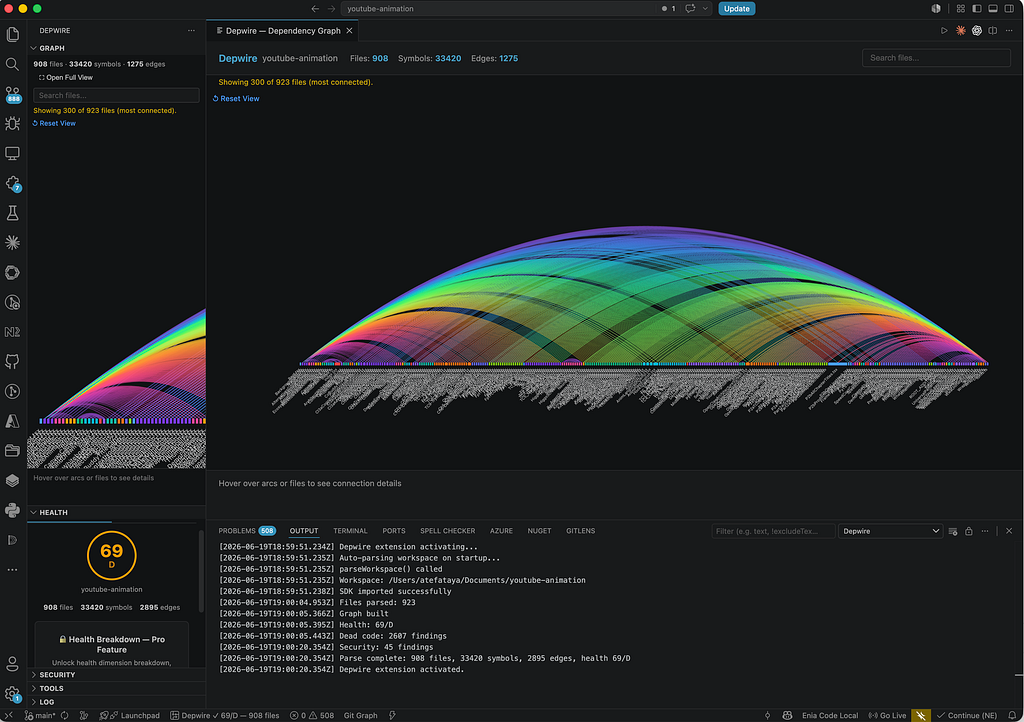
The arc diagram alone changes how you think about your codebase. Seeing 908 files connected by 2,895 edges — color-coded by language, interactive, hoverable — gives you spatial intuition about your architecture that no amount of file reading produces.
The health score
Beyond the graph itself, there’s architectural health scoring across six dimensions:
- Coupling — how tightly your modules depend on each other
- Cohesion — how focused each module is
- Circular dependencies — loops in the dependency chain
- God files — files doing too much
- Dead code — symbols no one uses
- Dependency depth — how deep your import chains go
Each dimension gets a 0–100 score and a letter grade. The aggregate gives you a single number to track over time. When your health score starts dropping, you know before the codebase becomes unmaintainable.
Security with graph context
Standard security scanners flag vulnerabilities in isolation. A graph-aware scanner can do something more useful: elevate the severity of a vulnerability based on how reachable it is.
A SQL injection in a function called only by internal admin tools is lower risk than the same vulnerability in a function called by your public API route. The graph knows the difference. A vector search doesn’t.
What If simulation
The most powerful feature for agentic workflows is the blast radius simulation. Before deleting or modifying a file, you simulate it. The tool shows you:
- How many files are affected
- Which imports break
- What does the health score become after the change
- The risk level: LOW / MEDIUM / HIGH / CRITICAL
This is what “map before you mutate” looks like in practice.
The architectural principle
The reason this works is simple. RAG answers the question “What looks like what I’m looking for?” A dependency graph answers the question “what is actually connected to what I’m looking for?”
For AI agents making code changes, the second question is the one that matters.
Embeddings are a probabilistic approximation of your codebase. A parsed dependency graph is a deterministic representation of it. When an agent is about to refactor something that touches 47 files, you want determinism.
Try it
Depwire is available as a VSCode extension — free to install, Pro features at $9.99/month.
Search Depwire in your VSCode Extensions panel, or:
ext install depwire.depwire-vscode
The CLI is open source at github.com/depwire/depwire — 16 languages, 23 MCP tools, works with Claude Desktop, Cursor, and any MCP-compatible agent.
Give your agent a map. It changes how you work.
Atef Ataya is a software architect and the founder of Depwire. He writes about AI agents, production architecture, and deterministic systems.