The Book Called Them in December. The News Caught Up This Week.
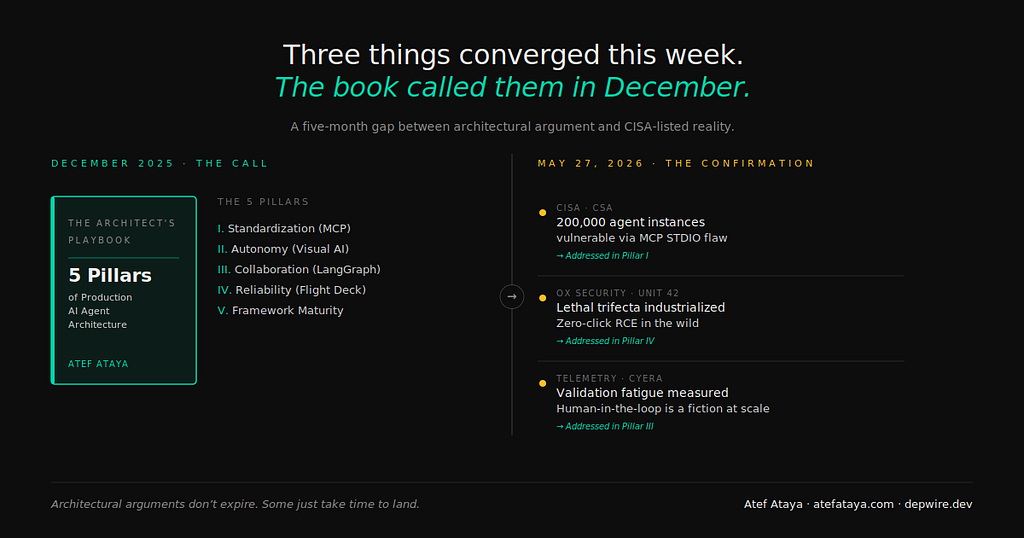
Three things converged in agentic AI security this week, and they make a case I made five months ago in print look less like an opinion and more like a forecast.
Over 200,000 active agent instances are now vulnerable to remote exploitation
The vulnerability is the protocol itself. The Cloud Security Alliance published research this month documenting a systemic design flaw in official MCP reference SDKs: the STDIO transport layer handles arbitrary execution paths without native input sanitization. Cursor, Windsurf, LiteLLM, LibreChat, all the popular frameworks built on these reference implementations are exposed. This is not a configuration mistake. It is a protocol-level problem that downstream multi-agent orchestrations inherit by default.
When I wrote The Architext’s Playbook in December, Pillar I (Standardization through MCP) opened with a deliberately uncomfortable framing: there is a difference between naive MCP usage and production MCP, and most teams shipping in 2025 were doing the first one while telling themselves they were doing the second. Connection pooling, session cleanup, dynamic tool registration, request concurrency limits, these were treated as production hardening that most published MCP examples skipped. Five months later, the protocol’s bare-metal usage pattern is on CISA’s radar.
The lethal trifecta has been industrialized.
Security firms are documenting active Zero-Click Remote Code Execution chains in the wild. The pattern is consistent: attackers place indirect prompt injections in public READMEs and issue comments, an autonomous coding agent ingests the poisoned content, and the agent’s MCP server is hijacked into dumping environment variables or executing system commands. Three failure modes, private data access, untrusted content ingestion, and external action authority, combine into one exploitation chain.
Pillar IV of the book (Reliability / Flight Deck) exists for this. The AgentExecutionGovernor pattern, circuit breakers on tool calls, token-bucket rate limits, and cost-aware retry logic are not nice-to-have operational disciplines. They are the difference between an agent loop that fails open and one that fails closed. The reason I built Depwire CLI as a deterministic, local-first static analysis tool is that the agent’s structural understanding of the codebase has to come from a layer that does not ingest untrusted content. Probabilistic context is a lethal trifecta vector. Deterministic structural truth is not.
The illusion of human-in-the-loop has now been measured.
Real-world telemetry shows that when an agent generates hundreds of tool calls per hour, human operators experience complete validation fatigue and rubber-stamp malicious payloads. The “human in the loop” safety claim that most enterprise pitches lean on is empirically a fiction at scale.
Pillar III (Collaboration via LangGrap) treats human-in-the-loop as a deliberate workflow pattern with explicit checkpoints, not as a generic safety mechanism. The architectural distinction matters: a workflow with one designed human checkpoint at a high-impact step is safe. A workflow that hopes a human will catch problems mid-stream is not safe. It is a liability dressed in safety language.
What this means practically:
The Sovereign Node argument is no longer ideological. It is the only configuration that survives a protocol-level MCP vulnerability and a four-hour internet scanning window.
Production MCP is not native MCP, and the gap between them is now exploitable at scale.
Validation fatigue is a measurable failure mode, not a hypothetical one. Human-in-the-loop has to be designed, not assumed.
If you are deploying agents in production this quarter, the architectural posture this week has shifted. The book I shipped in December is not the answer to everything that broke this month. But the pillars that addressed MCP hardening, execution governance, and structured human-in-the-loop checkpoint, those are called early, in print, with a publication date. The field is catching up to architectural arguments that were already on paper.
The Architect’s Playbook is at: https://www.amazon.com/dp/B0GCGB3B7Z
Depwire CLI is at: https://github.com/depwire/depwire