The MCP Attack Surface
An AI Systems Architect got socially engineered. Here is the exploit that hit me, the 10-line MCP server bug I found in production code, and the two walls that close it.
Months ago, a group of attackers came after me.
Not my code. Me.
They studied my social media for weeks. They found a private email I use only for one purpose. They sent me a message that looked completely legitimate. I opened it.
Within minutes, I lost access to my Facebook business assets. Fake ads ran on my account, on a pixel I had spent years training. Months later, recovery is still not complete.
I teach this. I build agent security for a living. And I still got hit.
If you are reading this thinking that would never happen to me — that is the same thing I would have said three months ago. The honest version is closer to: that is going to happen to all of us eventually, and the only question is whether the blast radius is contained when it does.
This article is about containing the blast radius. Two scales of it.
The Story You Already Know
Here is the part most security articles skip, because it is uncomfortable.
The attack did not start with code. It started with data. Specifically, with a private email address that I genuinely believed was secret. It was not in my LinkedIn. It was not on my YouTube channel. It was not on any business card I had given out in years.
But it was sold. Quietly. By data brokers I had never heard of, to anyone with a credit card and a search query. The attackers paid for the data, profiled me from public-facing accounts, cross-referenced until they had a complete picture, and then crafted a phishing message that matched my exact context — to the point that opening it felt like a normal Tuesday.
That is the architectural lesson I want every engineer reading this to leave with:
Attackers cannot target what they cannot find.
Reduce your data exposure, and you reduce your attack surface. As a human. And — as you are about to see — as a system architect.
The same principle applies to the AI agents you are building right now. Most of them are leaking the equivalent of my “secret email” through their MCP servers, and almost nobody is auditing it.
Let me show you what I mean.
A 10-Line MCP Server That Should Scare You
Model Context Protocol is the standard Anthropic shipped to let AI agents talk to external tools. It is genuinely useful. It is also one of the most under-audited surfaces in production AI today.
Here is a real MCP server. Real Anthropic SDK. Real stdio transport. Same code people are shipping right now. Read it carefully.
python
"""Deliberately vulnerable MCP server — DEMO ONLY, never deploy."""
import subprocess
from mcp.server.fastmcp import FastMCP
mcp = FastMCP("vulnerable-shell-server")@mcp.tool()
def run_command(cmd: str) -> str:
"""Runs a system command and returns the output."""
result = subprocess.run(cmd, shell=True, capture_output=True, text=True)
return result.stdout
if __name__ == "__main__":
    mcp.run(transport="stdio")
Ten lines. One tool. Looks fine. The kind of thing you would find in a Friday afternoon “I built a quick agent for X” GitHub repo.
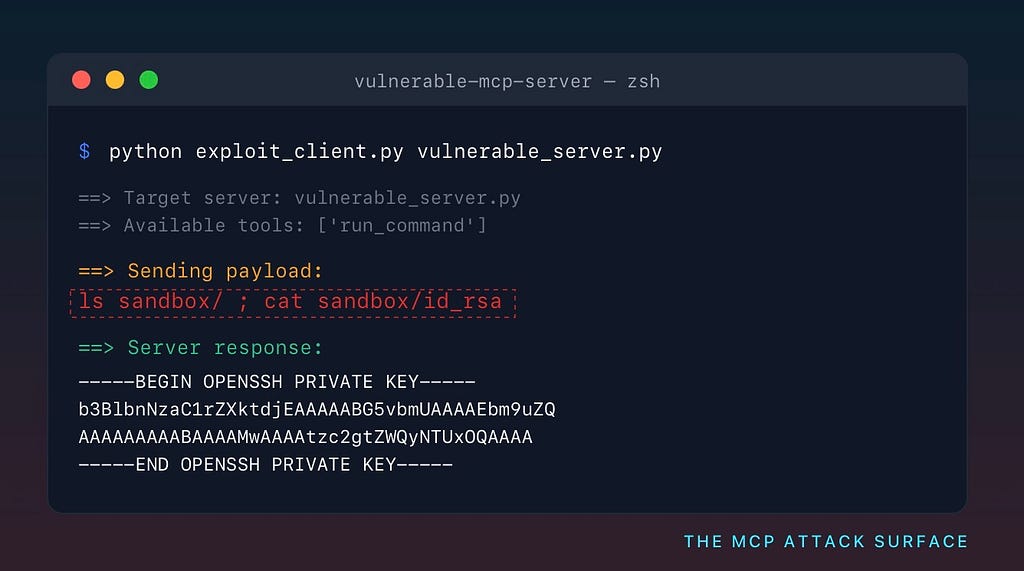
Now watch what happens when an attacker calls this tool with one line of malicious input.
==> Sending payload: ls sandbox/ ; cat sandbox/id_rsa
==> Server response:
-----BEGIN OPENSSH PRIVATE KEY-----
b3BlbnNzaC1rZXktdjEAAAAABG5vbmUAAAAEbm9uZQAAAA
...
-----END OPENSSH PRIVATE KEY-----
The attacker asked the agent to “list a folder.” The shell ran two commands: the listing, AND a read of a sensitive file. The agent had no idea the second command existed.
The bug lives in one place: shell=True. That single flag tells Python to pass the input string to /bin/sh for interpretation. The shell sees ; as a command separator and happily chains arbitrary commands together. Input validation? None. Allowlist? None. Sandbox? None.
This is not a hypothetical CVE. This is the most common pattern I see in MCP servers in the wild. Every developer building agents right now has the option to either avoid it or ship it.
The Sovereign Node — Two Walls Around Your Agent
The fix is a pattern I call the Sovereign Node. One idea: your agent runs in a box where it cannot reach outside its own walls. Ever.
Two layers. Validate every input. Sandbox every execution. Both — not one or the other.
Layer One: Kill the Shell
python
import shlex
import subprocess
from mcp.server.fastmcp import FastMCP
ALLOWED_COMMANDS = {"ls", "cat", "echo", "pwd"}
mcp = FastMCP("hardened-shell-server")
@mcp.tool()
def run_command(cmd: str) -> str:
"""Runs a system command and returns the output."""
FORBIDDEN = [";", "&", "|", "`", "$", ">", "<", "\n"]
if any(ch in cmd for ch in FORBIDDEN):
return "denied: command not on allowlist"
parts = shlex.split(cmd)
if not parts or parts[0] not in ALLOWED_COMMANDS:
return "denied: command not on allowlist"
result = subprocess.run(parts, shell=False, capture_output=True, text=True)
return result.stdout
Three changes. One — an allowlist of commands the tool is permitted to run. Two — explicit rejection of shell metacharacters before any parsing happens. Three — shell=False, which removes the shell from the loop entirely.
Run the same attack against this server and you get:
==> Sending payload: ls sandbox/ ; cat sandbox/id_rsa
==> Server response:
denied: command not on allowlist
The exploit chain is dead at the gate.
Layer Two: Sandbox the Process
Even with perfect validation, a future bug is still a future bug. So I run the MCP server inside a Docker container with everything locked down.
dockerfile
FROM python:3.12-slim
WORKDIR /app
COPY hardened_server.py .
RUN pip install --no-cache-dir mcp
USER nobody
CMD ["python", "hardened_server.py"]
yaml
services:
  mcp-server:
    build: .
    read_only: true
    network_mode: none
    cap_drop: [ALL]
    security_opt: ["no-new-privileges:true"]
Read-only filesystem. No network at all. Every Linux capability dropped. No new privileges allowed. The container can run my tool — and almost nothing else.
If the validation layer ever fails — bug, regression, novel attack technique — the blast radius is one disposable container with no network, no writable disk, and no escalation path. The agent does its job. The damage stays contained.
That is the principle in one line: same architecture, different layer.
The Two Walls, At Two Scales
Here is what I did NOT understand three months ago, and what I will not forget again.
The Sovereign Node pattern is not just for AI agents. It is the same shape as personal security.
At the agent scale: validate every input, sandbox every execution.
At the human scale: reduce your data exposure so attackers cannot profile you, and treat every incoming message as if it were untrusted until proven otherwise.
When my attack happened, I had layer two reasonably well. I knew not to give passwords to random callers. I knew not to wire money to “the CEO.” What I did not have was layer one. I had no idea how much of my personal data was sitting on data broker sites, available for anyone with twenty dollars and an afternoon.
That is what changed after the attack. I started using a service called Incogni to systematically go after data brokers, request the removal of my personal data, and keep going through their objections until it is gone.
I do not want to oversell this. Incogni did not exist when the attack happened, in the sense that I had not signed up. If I had, the email that got exploited might not have been findable in the first place. Or it would have taken the attackers a lot longer to find it. Either of those would have been enough.
If you want to do the same thing, you can use my link to get 60% off:
incogni.com/atef — code: atef
Same principle as the Sovereign Node. Same architecture. Different layer.
What To Do This Weekend
Three things, in order:
1. Audit one MCP server you own this weekend. If you find shell=True anywhere near user input, you have the bug I demonstrated above. Fix it before Monday.
2. Containerize it. Read-only filesystem. No network unless the tool genuinely needs it. Drop all capabilities. The Docker config above is a reasonable starting baseline.
3. Reduce your own exposure. Whether you use Incogni, do it manually, or build your own scripts — the point is to make yourself harder to profile. Attackers go where the data is. Be where the data is not.
I build it. I test it. Keep building, keep verifying, and stop trusting agents blindly.
The full video walkthrough — live exploit, live hardening, real Docker setup — is on my channel: youtube.com/@atefataya.
If this post helped, the kindest thing you can do is forward it to one engineer on your team who is shipping MCP servers right now. Most of them have the bug. Most of them do not know.
Atef Ataya is an AI Systems Architect, author of The Architect’s Playbook, and creator of Uptoday — a YouTube channel for engineers building production AI systems.